


At the bottom of this page: Latest news at this hour
Russia to ramp up drone production by 80%… Russian strikes cut 90 percent of Ukraine’s steel… Russia has attacked 300+ ships in Ukrainian ports… Election results in Russia and Germany are troubling…
Editor’s note:
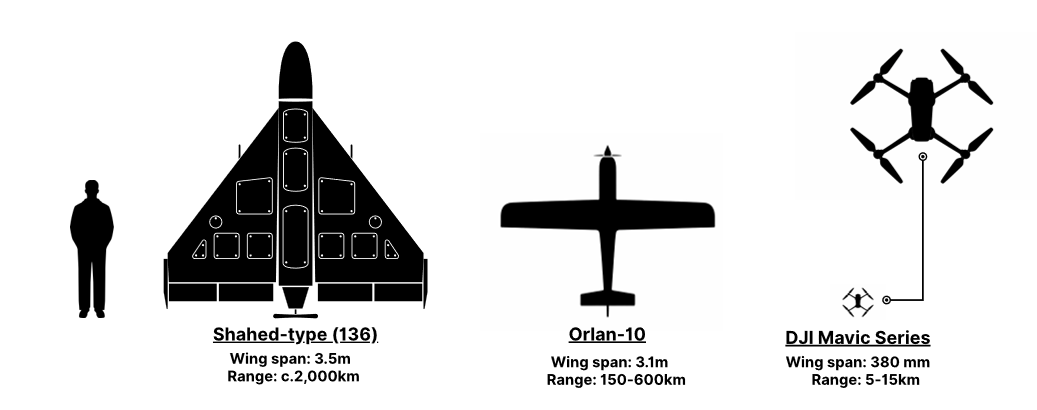
Our sister publication, The Arsenal, which covers defense tech, gathered a group of military veterans and drone experts to wargame the Battle of Mogadishu with one major change: Somali militia forces have access to about 150 cheap drones, like the ones used by Russia and Ukraine.
The U.S. has access to some larger drones (think Shahed and bigger) and some counter-UAS technology.
Want our human-interest stories to land directly in your inbox?
OUR LEAD STORY:
KYIV, Ukraine – Through this fictionalized account of the Battle of Mogadishu in the presence of drones, we are exploring a new way to understand the realities of modern warfare.
The following people were involved in this simulation, with their input interspersed into the scenario:
Retired Colonel Larry Perino, an infantry first lieutenant at Bravo Company, 3rd Battalion, 75th Ranger Regiment, who led a platoon on the ground during the 1993 Battle of Mogadishu
Luke Brawn, former military intelligence, deployed to Afghanistan, and current director of embedded operations at Sibylline, the world’s largest private intelligence firm
Justin Crump, founder and CEO at Sibylline, former tank commander in the Royal Armoured Corps with experience in Afghanistan, Bosnia, Iraq and Kosovo.
Alexander Lord, lead Europe-Eurasia analyst at Sibylline
Karan Vassil, intelligence analyst at Sibylline
Tim Mak, founder of The Arsenal and The Counteroffensive, former U.S. Army medic
Jacqueline Cole, Chief of Staff at The Counteroffensive Media
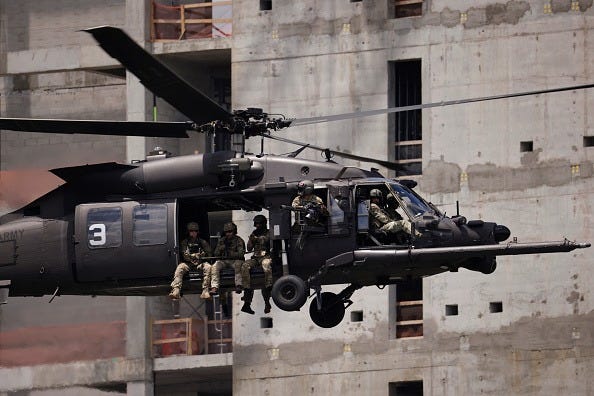
Black Hawks and Little Birds sat motionless on the tarmac at the American base in Mogadishu, Somalia. Their rotors still, their dark silhouettes shimmering in the humidity under the cloudless Somali sky.
That day was supposed to be an “off” day without the usual scheduled training. Members of Task Force Ranger were milling around the compound, playing volleyball, reading under rare pockets of shade, and working out.
Young American soldiers, many of whom were on their first deployment, were more relaxed than usual. That was until intelligence popped up indicating that a mission was developing. Soon, these men would load onto the choppers that would bring them to one of the most dangerous parts of the city: Bakara Market.
The mission was straightforward: capture two senior lieutenants of Mohamed Farrah Aidid, the leader of Mogadishu’s most powerful militia.
The U.S. Army believed capturing these two men would disrupt Aidid’s command structure as part of a broader effort to neutralize the warlord whose militia had become the primary obstacle to U.N. humanitarian and peacekeeping operations during Somalia’s civil war.
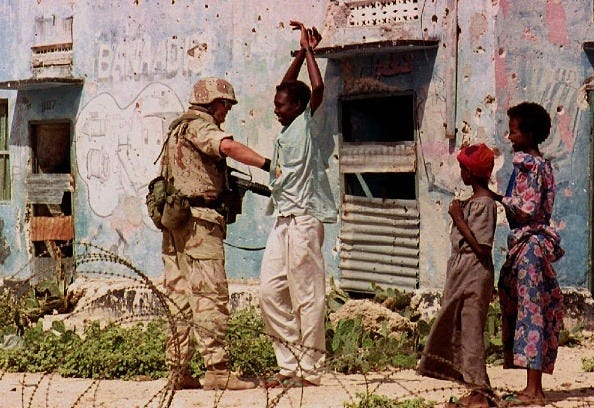
On the afternoon of October 3, 1993, Rangers obtained intelligence that a meeting between some of General Aidid’s deputies was happening in downtown Mogadishu, near Bakara Market, one of the most dangerous, armed parts of the city.
The Battle of Mogadishu, popularly known as “Black Hawk Down,” is notorious for the death of 18 American troops and hundreds – perhaps even thousands – of Somali casualties.
In the real battle in 1993, the largest aerial threats were RPGs and heavy machine guns firing toward the sky.
But in the following fictionalized version of Mogadishu, aimed at understanding the ways in which emerging drone technology will change special operations thinking, the Somali militia has cheap drones that they are using to surveil, to track, and to kill U.S. troops.
Americans have access to emerging counter-UAV technology, and infantry leaders are learning how to navigate threats from overhead and threats in their direct line of vision.
The same systems that define the battlefields in Ukraine now define the Battle of Mogadishu.
MISSION PLANNING
The American airfield in Somalia offered little protection. It sat at the bottom of a bowl, the Indian Ocean on one side, the city rising on the other. From rooftops, Somali civilians and militia members kept watch of the base through reconnaissance drones that cost less than a thousand bucks.
The Americans were being watched.
Constantly.
Larry Perino: We were right on the airfield, completely vulnerable.
The constant hum of drones overhead was, simply put, irritating, until the moment it became something more.
Justin Crump: If they had these capabilities, they’d be making life in the base pretty unpleasant, potentially, and certainly persistently unpleasant targeting high-value assets we’ve seen.
One night on the base, while a group of soldiers sat around playing poker with differently sized twigs as their chips, a drone launched onto a parked Black Hawk. It wasn’t enough to kill any troops — one young soldier on his first deployment took shrapnel to the cheek — but it was enough to raise the threat level for an already wary group of soldiers.
The American base was no fortress. Its security depended on U.N. forces responsible for protecting the airfield.
Inside the mission planning room, the attitude was all about speed and violence of action.
But if the militia could see helicopters lift off through drone surveillance, they could begin to mobilize before the Americans reached their target. Then they could pre-position fighters and drones in advance and plan a quicker, and therefore more lethal, response.
Commanders were also working with a tightly constrained deployment. Washington wanted a limited footprint: roughly 400 troops.

Both sides, in different ways, now had better pictures of each other’s strategies.
That is one of the asymmetric features of modern drone warfare – complex tools once thought to be the exclusive domain of powerful militaries are now available to much less sophisticated actors.
Luke Brawn: They’re getting a far more advanced warning than they would have done anyway. So [we’re] looking at the likelihood of better tracking of rotary assets moving into the area, a more immediate and coordinated response, and potentially looking at ambush on infill…
Black Hawks, though a large, juicy target for drones, were the fastest way to reach the target in the Bakara Market, and speed was foundational to success in this era of rapidly deployable drones.
The larger goal: do not get pinned down.
Justin Crump: The commander of this would be [thinking], ‘We can’t afford to get fixed because when we get fixed, they’re going to start flying things in quickly, and then that’s going to hurt us very fast.’
In Bakara Market, with drones overhead, stopping would be the most dangerous thing a soldier could do.
MISSION LAUNCH — ‘IRENE’
Seven Black Hawks and eight Little Birds lifted off from the airfield, heavy and loud, rotors chopping through the hot afternoon air. The Little Birds rose behind them, smaller and quicker, banking low toward the city.
From takeoff to target, the Americans had perhaps 10 or 15 minutes, and any minute longer was a minute closer to getting bogged down.
Below them, Mogadishu tightened into streets, alleys, and rooftops. Somewhere beneath the helicopters, men looked up. A few ran parallel to the path of the American helicopters, as if trying to keep up. Someone reached for a radio. Someone else shouted from a roof.
The American troops sat on the floor of the aircraft, rifles between their knees, boots dangling over the city.
While many Somali fighters knew that something was incoming, knowing was not the same as being able to form an organized reaction.
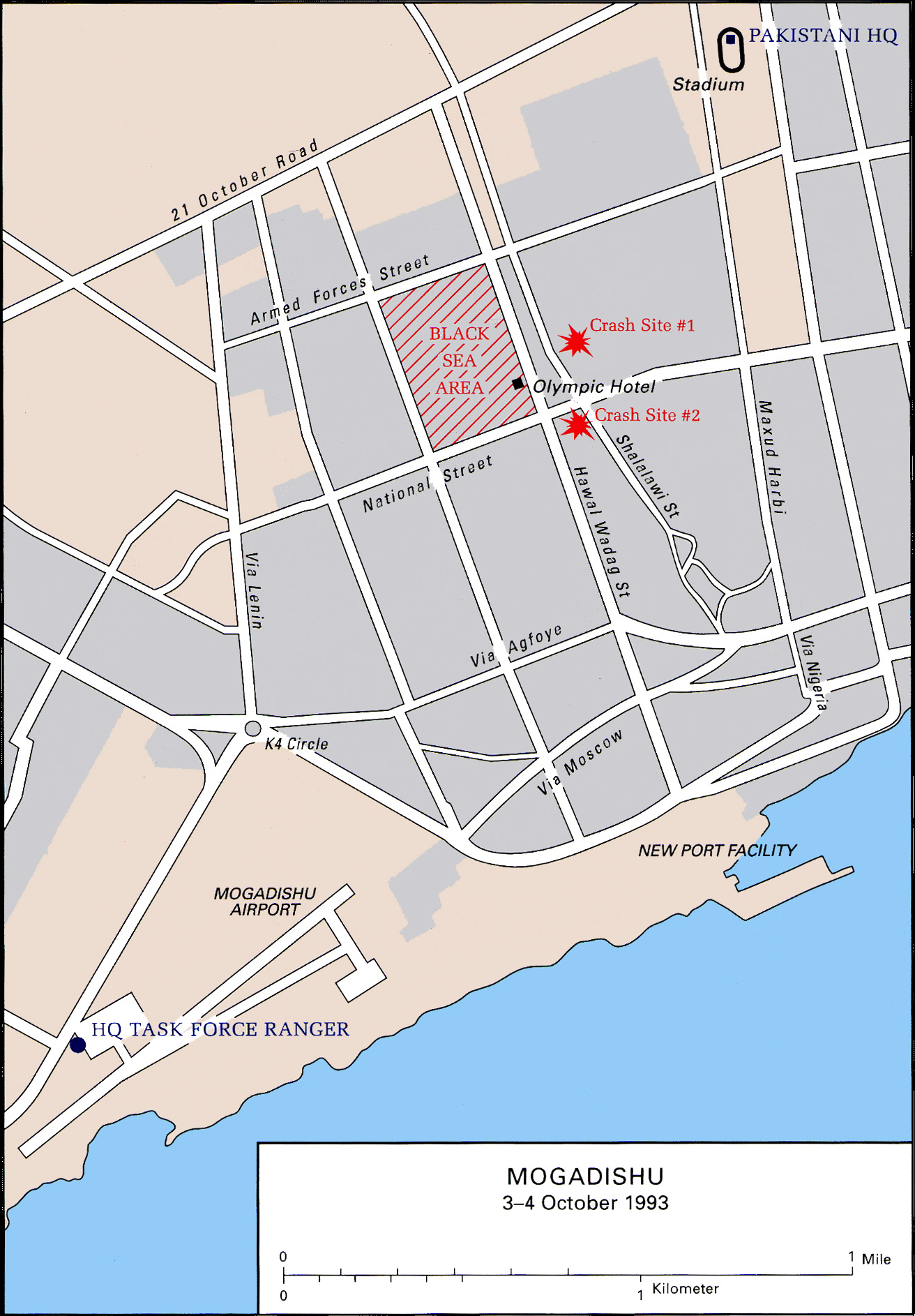
The helicopters reached the Olympic Hotel, one of the few buildings in the area that rose taller than surrounding rooftops, and stood just about a block away from where Aidid’s men were meeting.
Dust and debris whipped through the air as the Black Hawks settled into a hover above the street near the Olympic Hotel. The Little Birds peeled off, circling low, scanning rooftops and alleyways.
Ropes dropped out from the sides of Super 6-1, the first Black Hawk to hit the target area.
Rangers slid down, their boots hitting pavement just seconds later. Delta operators move straight for the target building, disappearing from beneath the helicopter within seconds. The assault is already unfolding exactly as planned.
Then, someone shouted, “Drone!”
The pilot of the Black Hawk abruptly jolts the aircraft, a split-second correction that was hardly felt inside, but for one ranger mid-slide down the fast rope. He lost his grip and crashed to the ground.
The drone veered, just missing the propellers by a few inches. It disappeared behind a building, leaving an unsettling sense of confusion in its wake.
Delta operators still hit the target building, and the assault moved with the speed it was designed for, but casualties were already a factor.
The raid seemed like a massive success. Delta forces captured Aidid’s lieutenants alive and shoved them into humvees.
But while most things were going to plan 40 minutes in, enemy drone operators were revving up, ready to engage in the action.
FIRST BLACK HAWK DOWN: SUPER 6-1
Then, the call came through: “BLACK HAWK DOWN.”
An FPV drone operator, alerted early to the operation, had managed to clip an American helicopter as it flew overhead.
Larry Perino: We had taken out the two key lieutenants and all the bodyguards, not a casualty [during the actual capture phase], and had them frog-marched out of the buildings, loaded them up into trucks. We were even starting to grab the fast ropes and put them into bags and start to exfil and move to the vehicle right when it got shot [down].
Seconds later, a column of smoke rose four blocks away, cutting above the rooftops of Mogadishu. Super 6-1 had been sent spiraling at fierce velocity toward the ground. Two crew members were killed upon impact, the other two were severely injured.
There was no pause, nor was there a formal reorganization. Rangers and Delta operators broke from the perimeter and started moving toward the crash site, some running straight through the streets, others cutting around buildings to find a faster route. The convoy was diverted under fire, pushing into the city to reach the wreck. Within minutes, roughly 40 troops were converging on the crash.
But the Somali militia was doing the same.
Now, with plumes of smoke rising from a massive, dormant, black vehicle, it was easy for drones to know where to go, even without strong coordination and communication efforts from Somali militias.
One lifted off from near the market. Another from a rooftop closer to the crash. Within minutes, several were overhead, their cameras locking onto the wreck and the Americans moving around it.
But Americans had new technology, too. What could have been a paper-map-based sprint through Bakara Market was now supplemented by live, continuous video feeds. Voices over the radio adjusted routes, corrected direction, and identified threats that soldiers on the ground could not see themselves.
Perino: “It would have been nice to have a GPS at that point because the maps sucked.”
But even with better navigation, the drones had changed the shape of the fight itself.
A small explosive fell from the sky and detonated the wall that had been shielding a group of rangers from incoming gunfire. A kamikaze drone landed near a Humvee that was attempting to push toward the crash site.
Luke Brawn: A lot of the pressure would be on the vehicles.
The small explosions were exposing the American troops, who were now seeking to take cover from ground-level gunfire and overhead munitions all at the same time.
Justin Crump: If you’re pinned down being shot at and you’re in cover and you’re either hiding for firing back, that’s one thing. If you’re doing all that, and effectively someone’s just standing 20 feet overhead dropping grenades on your head, I just think automatically that’s definitely a worse situation.
The Americans were also operating with more information than ever before: video feeds and aerial surveillance gave commanders real-time footage of the city, allowing them to redirect troops through crackling radio messages. That posed its own challenges .
Justin Crump: The human commander now is having to process so much information so quickly and act on it in real time. You’re almost immersed in this decision-making. You no longer get the luxury of sitting back and having a good assessment game… and if you stop, you’re going to come under fire.
SECOND BLACK HAWK DOWN — SUPER 6-4
Then, a drone hit another Black Hawk, Super 6-4, which crashed deeper inside the Bakara Market than the first.
Two members of the crew died upon impact, but the pilot survived. Rangers, Delta operators, and Somali fighters raced toward the wreckage almost simultaneously.
Now, there were two crash sites to rapidly secure. And cheap drones swarming over both made the task to secure them even harder — the Somalis had eyes on both crash sites. The Americans were fixed in place by the multitude of threats..
Justin: Once you’re fixed, things get bad much more quickly than what used to be the case.
Larry: You can’t solve [securing the crash site] with a drone… you have to put somebody on there.
Now, suddenly, infantrymen are starting to have to deal with technical items they’ve brought along: portable electronic warfare devices to jam incoming drone threats, a constant flow of radio intel from commanders back at the base receiving drone footage, and the unnerving reality of incoming small arms fire.
Now men trained primarily to fight had to process complex information the way drone operators and surveillance teams did in modern warfare. The defenders quickly became overwhelmed by a combination of threats and data.
Justin Crump: It’s almost like pre-smartphone era versus smartphone era. We’re getting more done, but we’re all frazzled.
The real EW advantage, though, is vehicle-mounted, in the form of devices strapped onto Humvees. But those Humvees arrived on a delay, not when drones were being launched from all sites at the onset of the crash, when they’d be most useful.
When the Humvees did finally arrive, they brought with them a bubble of protection: mobile protection, especially against radio-frequency-controlled drones.
Somali fighters compensated by posting on rooftops, watching American movement with their own eyes, and calling via radio to positions that were not within jamming radius.
Karan Vassil: This would have substantially compensated for the disruption to the [Somali] operator’s control/situational awareness, especially given the number of insurgents involved, their familiarity with the city, and their ability to observe U.S. troops.
In a drone-saturated battlefield, both crash sites became a magnet for incoming drones, which serve essentially as guided artillery rounds into the area.
For the sake of this scenario, we imagine that American forces suffered significantly more casualties than in the real-world Black Hawk Down episode.
Just how much worse is something even veterans and drone experts with careers in battlefield analysis can’t put a hard number on.
Justin Crump: It’s very hard to find the exact number of casualties, because actually …you’ve got better information coming into both sides. The Americans are getting a bit less in some ways, but they’re able to act on it faster. The insurgents aren’t able to act on it as well… but they have numbers… everything’s happening faster and more violently.
But what we can imagine is that every wall that had offered cover back in 1993 now had no protection from above, and presumably, those were life-saving walls. The conclusion is unanimous — casualties surely go up in the presence of cheap, accessible drones.
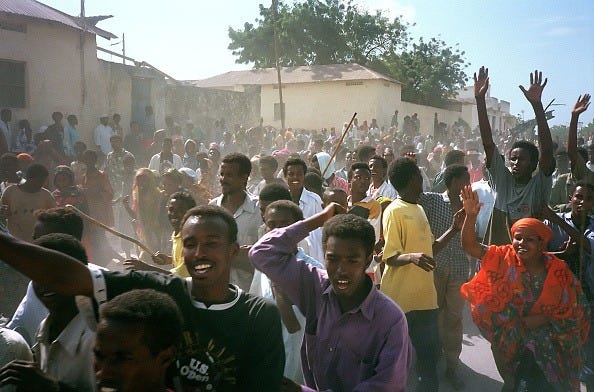
Every defensive position, casualty evacuation, and approaching rescue convoy could be spotted from above. American drones, while sophisticated, could not physically secure the position. Nor could they pull wounded crew members out from underneath burning helicopter parts.
Convoys attempting to reach the second crash site pushed aggressively through the city because slowing down risked turning every vehicle into an easy target.
Move too slowly, and drones will find you. Stop entirely, and the militia would close in around you.
And still, intense gunfights were lighting up the market.
RACE TO THE CRASH SITE AND NIGHT DEFENSE
By nightfall, the battle had slowed, but it had not stopped. Burned vehicles and helicopter debris lit parts of the city in an orange glow.
During the day, drones gave the Somalis a huge advantage, but at night, that advantage narrowed. American special operations forces were built for darkness. Rangers and Delta operators often carried night vision equipment – and were trained to fight, maneuver and communicate in low visibility.
The Somali militias, by contrast, only had a handful of night vision optics drones and limited ability to coordinate after dark.
Larry Perino: We had [an] even greater advantage of doing it at night anyway, but the problem is… it’s hard to find these guys in a city with a million people.
Now, the militias also faced another problem: ammunition and drone supply.
Hours into the battle, many of the small kamikaze drones and grenade-dropping systems had already been used. The commercial, off-the-shelf technology that the militias had adapted into weapons of war was no match for America’s superior logistics.
Somali drone operators became more selective, conserving what remained for high-value targets instead of throwing drones at every movement they detected.
For the first time since Super 6-1 went down, the Americans regained control over the chaos. The Americans, too, were low on medical supplies and ammo. No one had originally expected the mission to run into nightfall.
The Americans had air support from Little Bird circling overhead and AC-130s. Hundreds of Somalis were killed overnight, with little means to protect and fight in the pitch dark.
American casualties dropped, less than ten KIA that night.
DAWN RELIEF AND EXTRACTION — ‘MOGADISHU MILE’
By dawn, the city looked destroyed. Plumes of smoke lined the shallow skyline of the city; burned-out vehicles blocked major intersections, and the streets immediately surrounding the crash sites were littered with shell casings and dead bodies — mostly Somalian.
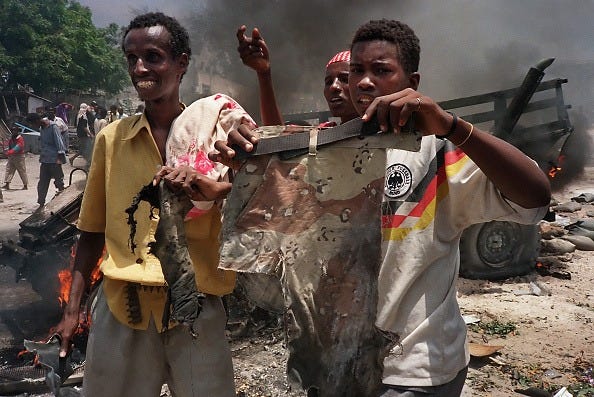
The relief convoy finally pushed toward the Americans at around 5 a.m. About 100 infantrymen from the 10th Mountain Division, Malaysian and Pakistani troops, and remaining U.S. Rangers and Deltas. At this point, less than 100 troops were left inside the perimeter.
The Somali militias now understood the Americans’ likely routes out of the city. Drone operators tracked the movement of armored vehicles from above, relaying positions as fighters rushed to establish new ambush points ahead of the convoy.
The relief convoy had to extract troops to a UN compound about a kilometer away on foot to the Pakistani stadium, the closest thing they had to safety.
Yes, the armored personnel carriers were limited, but whoever needed to get out of the market would get out.
This extraction needed to be fast, deliberate, and effective. The White House was watching. The world was watching. There was effectively real-time shaky drone footage of U.S. soldiers dying for the last 12 hours. The age of drones is also the age of social media, so what happened thousands of miles away in a desolate, militia-filled market had massive implications on politics back home.
CONCLUSION
Through trying to imagine the Battle of Mogadishu in the presence of modern drone technology, one thing becomes clear: we live in a world where small, cheap drones can take out massive, expensive things.
Two Black Hawks – each worth at least $20 million — can be downed and damaged by drones that cost a tiny fraction of that — sometimes as cheap as hundreds of dollars. The implication isn’t that helicopters are obsolete, but that militaries can no longer assume that technological superiority alone guarantees an overwhelming advantage.
There is an institutional question, deriving from the traditional, bureaucratic ways of the U.S. military, that complicates the idea that superior technology leads to superior outcomes.
A force built around drones from day one, like Ukraine, or like Somali militias in this thought experiment, adapts by necessity. A force that has built a command structure and best practices without the presence of drones has to unlearn centuries of habit, which is a more arduous fix.
Justin Crump: You can’t just shoehorn this in… [the Ukrainians] had to build their systems around having drones. We, on the other hand, have systems that work without drones, so we’re kind of challenged by their existence… It’s a fundamental reinvention of how we operate with this technology, and I think that’s what comes out of this scenario.
Modern drones also shift where the battle begins. Rather than waiting for helicopters over Mogadishu, Somali fighters could have struck Black Hawks and other critical equipment at their base, forcing commanders to protect their aircraft before they could even launch. In a drone age, the risk doesn’t always begin over the target.
We also live in a different information age. This whole incident is all on camera, for all the public to see. Back in 1993, a series of photographs turned this operation into a domestic political catastrophe. Within days, President Clinton had a timeline for withdrawal from Somalia in the next six months.
Now, imagine the extent of images and videos acquired by drones that would land on millions of civilian phones and TV screens with zero delay.
Drone feeds, filmed from angles no journalist could ever capture, uploaded live, of a Black Hawk spiraling out of control over a busy Somali street. Dead and injured American casualties broadcast by social media accounts with no sense of decency.
Before the Pentagon has even confirmed the crash, military analysts on Telegram and YouTube are dissecting each step and misstep. There is no way for the U.S. government to shape the narrative of its special ops on a mission-gone-wrong.
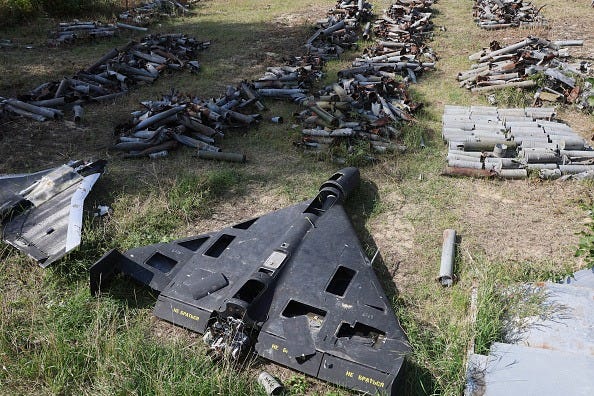
Finally, drones have changed the game of reconnaissance and surveillance – in the original Battle of Mogadishu, Somali fighters were constrained primarily to word of mouth and grassroots information-sharing.
In this simulation, drones gave them a constant view from above, allowing them to identify crash sites and coordinate attacks with rapid speed. Nowadays, almost anyone with a modest budget can obtain real-time intelligence in large quantities.
But the challenge that still remains, despite technological innovation, is the know-how to use that intelligence. Drones do not erase the advantages of elite training and logistics.
But they do allow lesser-resourced groups to exploit the vulnerabilities of stronger ones. If the Battle of Mogadishu took place in 2026, it would likely tell the story of how the cheapest technologies can reshape the tempo, and the outcomes, of modern war.
Interested in reading more stories about drones? Check these out:
Nighttime with Ukraine’s drone hunting teams by Myroslava Tanska-Vikulova, William Glover Weiss, and Oleksandr Matviienko
Ukraine’s interceptor drones help arm pacifist Japan by Petro Gordon
Inside the first ever all-drone assault by Ukraine by Tim Mak, Oleksandr Matviienko, and Mariana Lastovyria
Editor’s Note:
Our sister publication, The Arsenal, which covers defense tech, gathered a group of military veterans and drone experts to wargame the Battle of Mogadishu with one major change: Somali militia forces have access to about 150 cheap drones, like the ones used by Russia and Ukraine.
The U.S. has access to some larger drones (think Shahed and bigger) and some counter-UAS technology.
Support our newsroom so we can bring more unique stories to your inbox!
THE LATEST NEWS AT THIS HOUR:
By: Oleksandra Khelemendyk
Good morning to readers; Kyiv remains in Ukrainian hands.
RUSSIA TO RAMP UP DRONE PRODUCTION BY 80%: According to Russian plans obtained by Politico, Russia plans to scale up its production of drones by about 80 percent. By 2029, the Alabuga-Volokno plant in Tatarstan, Russia, will increase its yearly output of military-grade aerospace carbon fiber by about 500 tons, a material used to build drones. This will allow Russia to make another 28,000 attack drones per year, in addition to current production of 36,000.
Most likely, similar drones have been used to strike a passenger train carrying EU and U.S. officials near the Polish border on September 13 and have also been flown into NATO and EU airspace. As these provocations from Russia increase, Poland will install over 1,000 new sirens on its eastern border to notify civilians about potential drone and missile threats.
RUSSIAN STRIKES CUT 90 PERCENT OF UKRAINE’S STEEL: The Financial Times reported that Russian attacks earlier in September forced three major Ukrainian steel production plants to close indefinitely. Located in the Zaporizhzhia and Dnipropetrovsk regions, these plants accounted for about 90 percent of Ukraine’s steel output. It may take months or even years for these plants to restore production.
The factories used to employ over 15,000 people and contributed significant funds to Ukraine’s tax revenue. Russian strikes on warehouses, steel plants and railways mean Ukraine’s tax revenue is set to take a hit of $1.5 billion.
RUSSIA HAS ATTACKED 300+ SHIPS IN UKRAINIAN PORTS: The head of the Ukrainian Port Association, Dmytro Barinov, said that Russia had damaged at least 1,000 pieces of port infrastructure and over 300 commercial vessels, killing more than 200 international crew members. Barinov also said that Russia “hunts” civilian vessels sailing under foreign flags.
Russia and Ukraine intensify attacks on each other’s Black Sea ports, prices of wheat have jumped to a three-year high, and combined exports from both countries have dropped by half, compared to 2025. As a result, Egypt, the world’s largest grain buyer, hasn’t received any shipments from the Black Sea in about a month. Ukraine is a major producer of grain and is a major supplier for many countries in the Global South.
ELECTION RESULTS IN RUSSIA AND GERMANY ARE TROUBLING: Over the weekend, Russia held parliamentary elections to the State Duma. Partial official results show that the current ruling party, Vladimir Putin’s United Russia, is set to win with 57 percent of the vote. Such high support is attributed to tight political control in Russia and might also indicate high approval of its war against Ukraine.
In the German state of Mecklenburg-Western Pomerania, the far-right Alternative for Germany (AfD) came first with 38.3 percent of the vote. The Chancellor Friedrich Merz’s party got only 4.9 percent, below the 5 percent threshold to take any seats at the state parliament. This is the worst result for the Christian Democrats since 1949, while the strength of AfD is growing across German cities after it won the state elections in Saxony-Anhalt on September 6.
CAT OF CONFLICT:
Zoriana saw these cats cuddling in the straw. It’s getting colder outside, so a little hug wouldn’t hurt.

Stay safe out there!
Best,
Tim and Jackie.