


At the bottom of this page: Latest news at this hour
Ukraine struck with ballistic without warning from partners… Trump forces Kyiv to surrender… NATO $1 billion+ drone defense investment expands to Poland…
Editor’s note:
This story was reported in Kyiv by The Counteroffensive, an independent newsroom of journalists covering Ukraine through the stories of the people living through the war.
Why are audiences drawn to real-life crime? Where does the line run between remembering victims and exploiting them? And how should the genre be covered ethically?
Here, those questions are asked in a country where violence is a part of daily life.
OUR LEAD STORY:
KYIV, Ukraine – Each time Viktoriia recorded the final lines of her video, tears welled in her eyes, and her voice cracked.
“It was difficult for me to record a video about the hijacking of a bus carrying children. The children were later released, and they all survived. But what about their lives after that incident? Some struggled with alcohol, and some took their own lives. In these stories, even if you survive, how do you go on living?”
She was referring to the 1976 Chowchilla kidnapping in California, one of the largest mass abductions in U.S. history.
Viktoriia Barkova is living through war and the daily nightmare of Russian missiles and drones, but it was not that harrowing reality that brought her to tears.
It was the faraway reality of distant strangers from decades ago that hit her like a gut punch. Viktoria is the creator of a Ukrainian-language YouTube channel that covers real-life crimes. She launched it during the full-scale invasion, and even though she posts new videos about once a month, the channel is growing extremely fast, reaching 40,000 subscribers in two years.
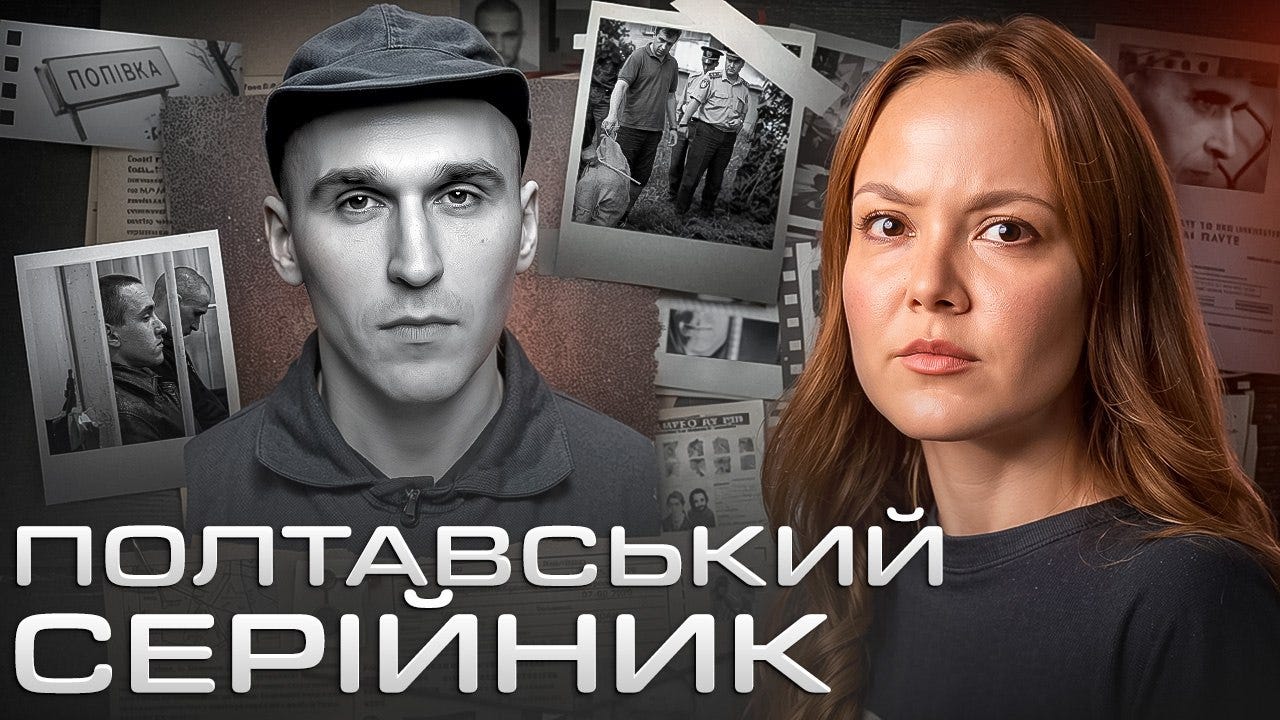
At first glance, it’s a paradox. Ukrainians read about their fellow countrymen killed in missile strikes every day and spend nights in hallways bracing for certain death amid air raid sirens. They are literally living in a ‘true crime’ scenario. Yet, every evening, thousands of them watch hour-long YouTube videos about serial killers.
It makes more sense than you’d think. More than four and a half years into the war, Ukrainians are exhausted. Last winter, 91 percent reported severe stress, and nearly half now deliberately avoid news about the war.
The content people consume reveals how a country copes when the danger never ends. True crime offers a story with a clear ending where the culprit is usually caught.
“[In true crime] there’s a certain structure and a timeline. Eventually, the criminal is apprehended… I think this gives the mind a sense of relief,” said Viktoriia.
As Ukraine prepares for another winter of Russian attacks, the rise of the genre shows how millions are trying to regain a sense of control.
Since 2022, many Ukrainian-language true crime channels have emerged, with the biggest reaching 300,000 subscribers. Viktoriia was among those who launched their own true crime channels in 2024, while the war was already underway. Before that, she grew her Instagram by sharing beauty products with her audience.
“Before the war, life felt like a field of daisies, butterflies fluttered and birds sang,” said Viktoriia. “I don’t feel that way anymore. That’s why I have a true crime channel [now].”

When she launched her own channel, Viktoriia understood Ukrainian viewers’ need for Ukrainian content. Five years into the war, 71 percent of Ukrainians still regularly consume Russian-language content. Researchers cite the lack of high-quality Ukrainian alternatives as the main reason.
The popularity of the true crime genre is not unique to Ukraine. According to Edison Research, true crime surpassed comedy for the first time in the second quarter of 2026 to become the most popular topic among podcast listeners in the United States. In 2019, it ranked fifth.
“I spend a very long time choosing each topic,” Viktoriia said. “Sometimes I find one that seems really interesting and substantial, and it turns out [another Ukrainian true crime creator] has already done it. I try to pick a story that I’m interested in researching myself, and it also depends on how much material there is.”
Viktoriia often draws on American case files when putting together material for her videos. These include photos, videos, and interrogation transcripts. For Ukrainian cases, however, there is often only one article since data transparency regarding such cases in Ukraine is significantly lower.
“It’s rare to find a substantial amount of information on a Ukrainian-language case,” she said.
Now, as her channel grows more popular, Viktoriia feels especially responsible for the result. “I feel people’s expectations. They know I try to cover everything in depth, that every detail has to be there. So I keep asking myself: did I really find everything? Did I really work through everything? I have a notebook where I write down every point that needs to be covered,” she said.
In one of her videos, Viktoriia asked her viewers why they watch true crime content. The responses fell into two categories.
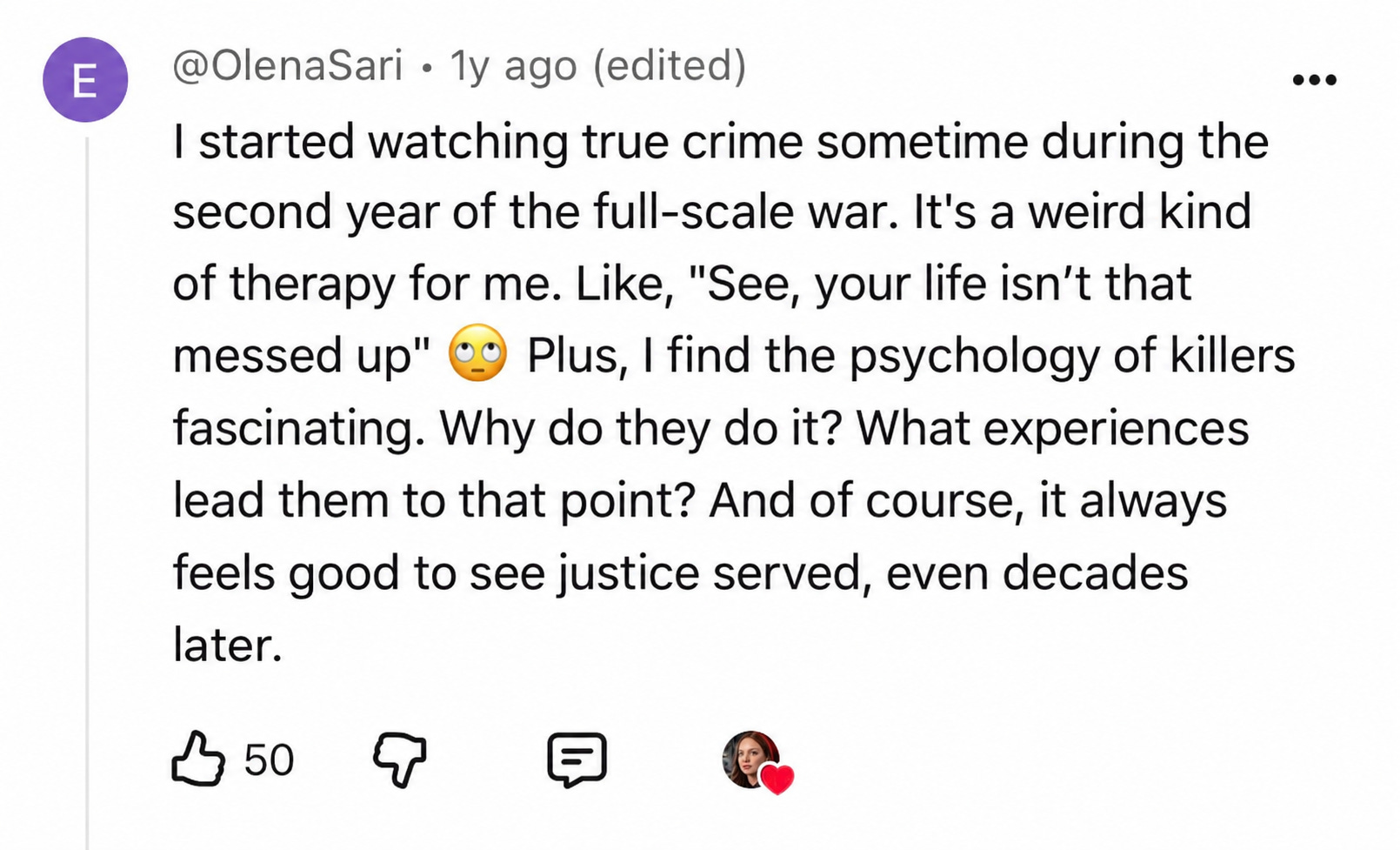
Some wrote that they were interested in understanding the logic of criminals and trying to figure out if there were warning signs that could have been spotted earlier. Others explained that, during wartime, stress levels are so high that they need a different kind of controlled stress.
Viktoriia agrees with this logic, which is precisely why she doesn’t take on unsolved cases. “My brain can’t handle it when there’s no captured criminal,” she said.
According to research from University College London, uncertainty causes far more stress than the stressor itself. For Ukrainians, uncertainty has become a way of life. No one clearly knows where enemy missiles are headed, whether there will be heat in the winter, or when the war will end.
True crime offers the opposite. The viewer knows in advance that the criminal has been caught. In this way, controlled stress can build resilience. During the pandemic, horror fans reported fewer symptoms of depression, anxiety, and insomnia. Additionally, people interested in killers and violence were found to be more psychologically resilient.
This genre’s audience is predominantly female, and Viktoriia’s viewers specifically want more stories about women. They are particularly drawn to stories that teach them how to defend themselves against an attacker.
This trend also has a dark side. A third of Americans believe the genre exploits victims and their families, and almost a half believe that it sensationalizes violence. In Ukraine, where photos of people killed by Russian attacks are published daily, the question of where to draw the line between news coverage and sensationalism is particularly pressing.
Viktoriia is careful to respect the victims. “I don’t like it when true crime stories romanticize criminals or treat victims like names on a list,” she said. “By telling the victims’ stories, these people are remembered.”
The way she sees it, understanding a criminal’s background is important in some situations.”If someone had noticed back then that he [the killer] was very aggressive toward animals… It’s important to look at the background and understand what we, as people who could have dealt with this person, might have missed, and how we could have prevented what happened next,” Viktoriia said.
For viewers, this is another way to feel a sense of control, to make sense of what is otherwise senseless violence — something Ukrainians have no choice but to be all too familiar with.
Christa Pike, for example, became notorious for an extremely brutal and sadistic 1995 murder that was back in the headlines last month after Pike survived her execution by lethal injection. For years, her lawyers have argued that physical and sexual abuse she suffered as a child should be taken into account.
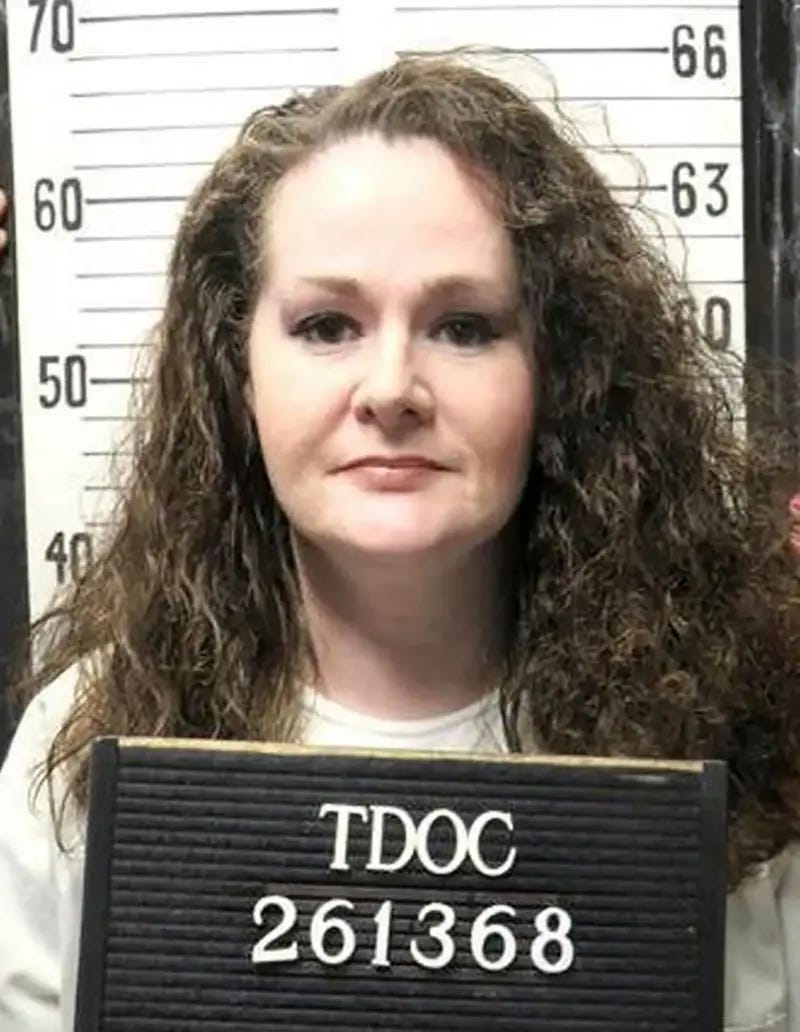
“I don’t think we can excuse it with childhood,” Viktoriia said. “But maybe for us, as viewers, it shows a certain cause and effect.”
In Viktoriia’s opinion, sensationalism begins when an author focuses on a high-profile criminal while forgetting about the victims. She believes that is exactly what happened in the Lindsay Clancy case, which is why she does not plan to cover it until there’s a resolution in court.
On September 4, a Massachusetts court declared a mistrial in the case of Clancy, a former nurse who strangled her three children in 2023. After seven days of deliberation, the jury could not reach a verdict on her criminal liability because the defense argued that she was suffering from postpartum psychosis. Talks are still underway on when, or if, there will be a retrial.
True crime narrators often sound low and ominous, but Viktoriia’s own delivery is serious and measured. Some subscribers told her that, with a voice like hers, she should be reading fairy tales instead of true-crime stories.
“Maybe I really should be reading fairy tales. Maybe when the war ends, I’ll be able to return to a place where I can feel a field of daisies again. Time will tell,” said Viktoriia.

Interested in reading more stories about crime in wartime Ukraine? Check these out:
Hypocrisy behind a Ukrainian refugee’s murder by Mariana Lastovyria and Tim Mak
Should Ukrainians have legal guns? by Kateryna Antonenko
Dead journalists. by Myroslava Tanska-Vikulova and Tim Mak
Editor’s Note:
I’ll confess something: I’ve been drawn to true crime for years. While working on this story, that passion turned into a moral dilemma.
In Kyiv, violence has become part of everyday life. We fall asleep to explosions and wake up to the names of the dead. So why, after all that, would I choose to spend my evenings with stories of murder? Have I blurred the line between ordinary life and violence so much that I no longer notice it? Or have I simply become hooked on adrenaline, the way war teaches you to be?
You’re the reason our authors could spend weeks on a story looking for the answer to complicated questions. Support our team!
THE LATEST NEWS AT THIS HOUR:
By: Petro Gordon
Good morning to readers; Kyiv remains in Ukrainian hands.
UKRAINE STRUCK WITH BALLISTIC WITHOUT WARNING FROM PARTNERS: Russia recently has struck Kyiv with five ballistic missiles, however Kyiv received no warning from western partners, according to Zelenskyy. The air alert came moments after the missiles had already hit, showcasing the importance of western intelligence for Ukraine’s warning systems. Without these warnings, it is not possible for Ukrainians to reach shelters in time.
This comes after the Trump administration threatened to end intelligence sharing with Kyiv and block the arms sales through the PURL mechanism if Ukraine continues to bomb Russian oil refineries.
TRUMP FORCES KYIV TO SURRENDER: Trump’s administration is attempting to force Ukraine to surrender, to prevent Ukraine from attacking Russian oil refineries, Anne Applebaum writes for The Atlantic. Trump has repeatedly tried to blame rising global fuel prices on Ukraine, but in reality Trump wishes to profit from business deals with Russia, including ones in the energy sector.
Yesterday, Donald Trump announced an “energy ceasefire” without notifying either side. Russians promptly violated the ceasefire by striking a power plant in Kharkiv. In the past, Trump has said that Putin is more willing to reach a ceasefire deal than Zelenskyy.
NATO $1 BILLION+ DRONE DEFENSE INVESTMENT EXPANDS TO POLAND: With the threat of Russia on its eastern flank, NATO is looking to invest into drone defense technology. The joint fund of more than a billion dollars is expanding into Poland, looking for direct investments into the latest dual-use technologies to counter the rising drone threat from Russia, Reuters reports.
The war in Ukraine is pushing NATO to shift its defense strategy, focusing on drones, which has become a key instrument in Russia’s hybrid attacks against NATO member states.
DOG OF WAR:
This dog followed Ally on her way home today.

Stay safe out there!
Best,
Ally.