
Taiwan’s shrinking population is a national security threat
An OBGYN in Taipei explains why Taiwanese women are not having kids, and why that could mean danger for the island's future.

At the bottom of this page: Latest news at this hour
Zaluzhnyy: Ukraine will never join NATO; Romania imports energy from Ukraine; Georgian oil refinery turns away from Russian oil; Trump to give Taiwan $14 billion arms package; Taiwan to raise awareness about China’s influence.
This is our monthly supplemental issue on Taiwan!
We believe that empathy and authoritarianism can’t mix – that when we tell deeply-reported human stories of people threatened by dictators, it compels people to act against injustice.
Want our human-interest stories to land directly in your inbox?
OUR LEAD STORY:
TAIPEI, Taiwan – When a baby smiles with doe-like sparkling eyes, makes babbling sound, or giggles, most parents melt.
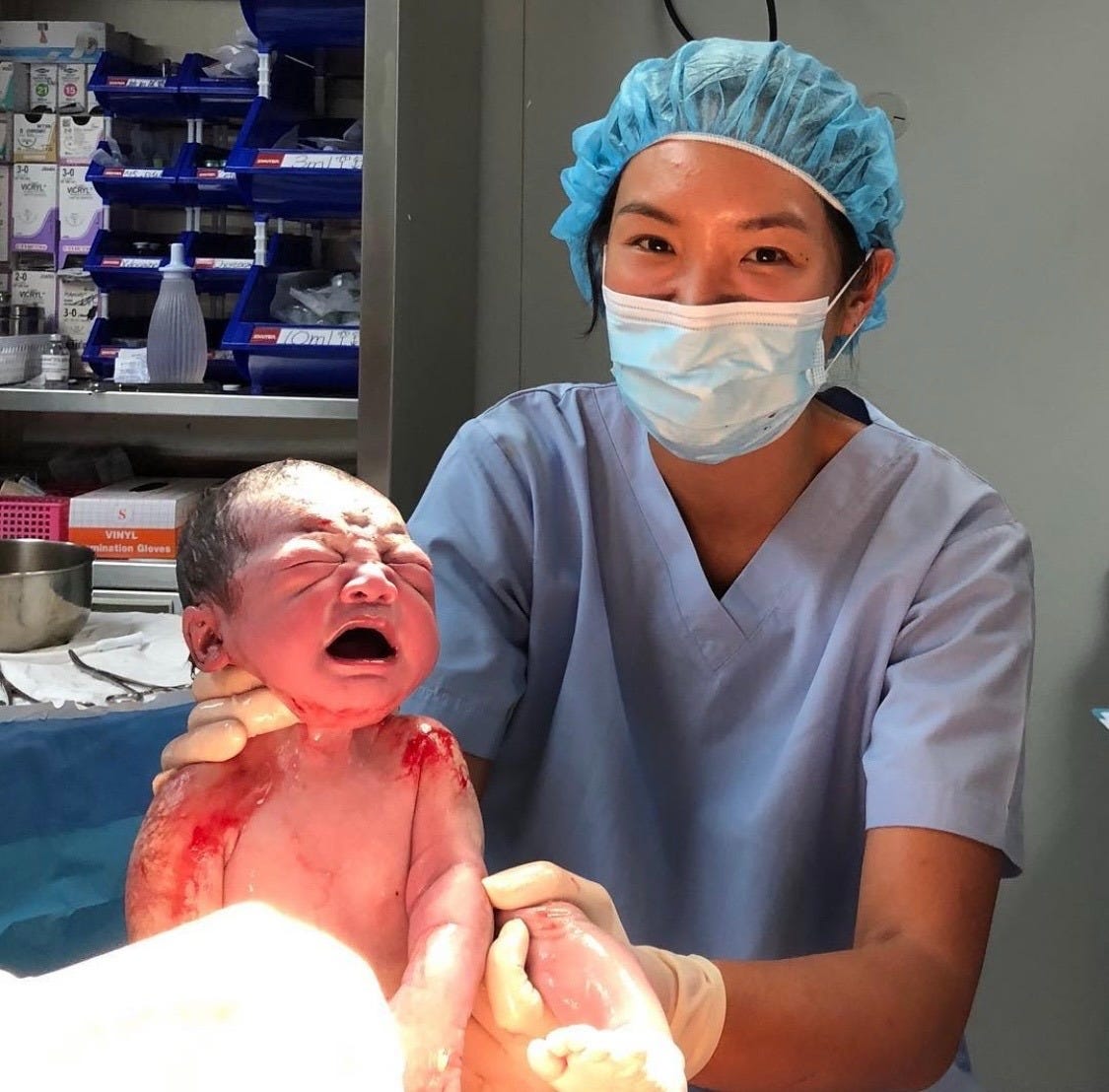
Dr. Wu En-Tsz, an obstetrician-gynecologist working in Taipei, has seen countless adorable babies. When she sees the first ultrasound image of a new life, she feels delighted.
As much affection as she has toward newborns, she doesn’t want one herself. “I often tell people I’m an OB-GYN who doesn’t want to have a baby,” said En-Tsz, who works for Dianthus MFM Clinic. “I want to focus on myself more instead of taking care of others.”
Taiwan is just one country experiencing a gradual decrease in birth rate — now a global trend.
The responsibility of bearing children, and often raising them, has always fallen on women, but modern women are feeling suffocated and reluctant to sacrifice their careers for children. With the addition of economic burdens such as rising housing prices and limited care-taking resources, more and more families hesitate to have kids.
But in Taiwan, this is becoming a national risk issue; as Beijing intensifies its gray-zone warfare and cross-strait tensions by sending fighter jets across the middle line of the Taiwan Strait or coast guard ships around Taiwan to challenge the authority of the Taiwanese government, Taiwan’s plummeting birth rate represents a severe existential vulnerability.
China has a population of 1.4 billion. Taiwan, with only 23.4 million people, is less than 0.02 percent that of its adversarial neighbor. In addition, the birth rate of Taiwan hit a record low last year, and the lowest globally. The data published predicted that by 2065, the population of Taiwan would be cut in half.
Some solutions include expanding conscription to women and enhancing autonomous technical system, according to a report published in April by The Institute for National Defense and Security Research, a Taiwanese think tank.

En-Tsz is not your typical OB-GYN. She has a sleeve of tattoos on her right arm; the most noticeable one is a snake wrapped around a bleeding pen. The tattoo sometimes causes hostile attention, and encountering judgmental clients can be difficult.
“When they are not satisfied with the medical service, they often target my tattoo,” En-Tsz said.
She recalled her experience in the second year of her internship as a resident physician. “I’ve seen mothers with cancer, and some just had babies not long ago. I felt terrified,” En-Tsz said.
Unlike most doctors, who specialize in a single organ or system, En-Tsz finds fulfillment in guiding new life from conception to birth. She chose to become an OB-GYN because she prefers to deal with life than with death.
The families — her patients — always share their happiness with her. “I often heard them tell me that I’m the first person their baby sees. It makes me feel close to them.”
Increasingly, though, she’s detecting fewer births.
And, in some ways, this decrease in birth rate is a warning sign to the country’s future military strength is weakening. Taiwan’s military manpower has already been declining in recent years. Data from the Ministry of the Interior shows that the number of conscripts in 2022 hit its lowest in nearly 10 years. The amount of filing early retirement surged from 401 in 2020 to 1,565 in 2024, about four times growth in just four years.
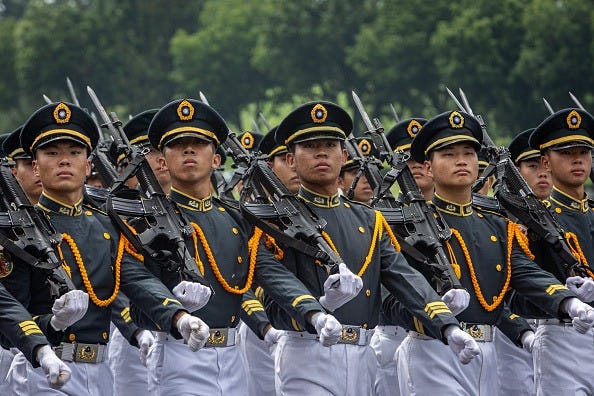
Taiwan’s Defense Department admits that the number of eligible men to be conscripted has also been falling. The number went below 100,000 for the first time in 2023. But the prediction says it could fall lower than 80,000 due to the birth rate drop.
Air defense pilots may be hit hardest. Chinese PLA fighters have become much more aggressive in the past five years by sending fighter jets across the middle line of the Taiwan Strait, so Taiwan needs to speed up recruiting eligible pilots. But according to congressional data, the island only added 21 fighter jet pilots from 2011 to 2019.
One of the many reasons why some women today refuse to have children in Taiwan is that they feel that raising children falls primarily on them.

“Men weren’t educated to manage a relationship,” said En-Tsz, who shared her own experience. Her father was a sailor who did not spend much time taking care of her when she was little. After her parents’ divorce, her mother disappeared. Her father needed to work on the ocean for long periods, so his sister — her aunt — raised her.
Looking back on her childhood, En-Tsz did not see clearly what a father’s role should be. “I didn’t get to see what a complete family was supposed to be like.”
As a neglected child, En-Tsz was afraid to have a kid who could suffer the same upbringing. “I’m not very good at being a caretaker,” she said.
“I got married because I want to find someone to have a family,” she added, but her family plan doesn’t include having a baby. Two people supporting each other is enough.
Taiwanese women are becoming more empowered to pursue their careers, but society lags behind in supporting pregnancy while pursuing a career.
Ironically, some independent women looking for better careers chose to serve in the military. Taiwan’s Defense Department renewed its recruitment standard to broaden the inclusion of female soldiers in 2018, and the gender ratio has been growing.
Besides expanding women’s recruitment, the military increased incentives to join. In June, 2025, Taiwan’s Congress passed a bill adding around $1,000 in subsidies per soldier. Since this July, the military has started incentivizing birth by extending the unpaid leave of absence period for service crew members.
Maternity and childcare leave are granted by law in Taiwan. But outside of the military, women pursuing higher positions are less likely to use it for fear of losing opportunities for promotion, according to Leona Cheng, a full-time sales at an engineering company. Daycare or close family is sometimes an option, but unexpected incidents happen; when a child stays home sick, a mother often must stay home.
If a man is expected to economically support the family, they inevitably share less of the burden of taking care of the baby.
Limited public resources are also a factor: public childcare centers are sufficient to cover only 4 percent of Taiwanese babies aged 2 years old. Education costs have risen to a record high, and rising inflation places additional strains on would-be Taiwanese parents.
“I feel my kids would live in a difficult era,” Lia Hsu, a mother with two kids working in the tech industry, said. “My kids are lovely, but I work so many hours a day. It’s hard for me to spend quality time with them and at the same time balance my career.”
For those who work outside of the tech industry, their salaries are lagging behind their assets. The burden of debt is just another obstacle between a woman and having a child.

Traditional family expectations and a difficult child-bearing society might be significant reasons for Taiwanese women to avoid seeking children, but building a solid safety net to protect future talents is crucial for the island under threat.
Since Russia’s full-scale invasion of Ukraine, the Taiwanese military has been learning to build a more autonomous defense, involving more drones. But even that is facing a manpower problem — data from the Budget Office last year showed a severe shortage of drone operators. The army planned to train 1,000 operators in the year, but only released 300 training spots due to the lack of drone training talent.
En-Tsz believes too many talents in Taiwan are flooding into the tech industry, shrinking the talent in other fields, including defense.
“A bigger population doesn’t always guarantee victory in a war,” En-Tsz said. But a country like Taiwan, without a consolidated security net, could be in serious trouble if the birth rate continues on this downward spiral.
Interested in topics about Taiwan? Take a deep dive into some of our related coverage.
Same-sex couples find a haven in Taiwan
Taiwan imagines: What happens the day China invades?
Taiwan stinky tofu stalls hit by Iran war shock
Editor’s Note:
This is our monthly supplemental issue on Taiwan!
We believe that empathy and authoritarianism can’t mix – that when we tell deeply-reported human stories of people threatened by dictators, it compels people to act against injustice.
Agree with us? Upgrade now to support our work.
THE LATEST NEWS AT THIS HOUR:
By: Mariana Stadnyk
ZALUZHNYY: UKRAINE WILL NEVER JOIN NATO: Ukrainian ambassador to Britain and former Commander-in-Chief Zaluzhnyy believes that Ukraine’s accession to NATO is not viable, Evropeiska Pravda reports.
Zaluzhnyy expressed skepticism over NATO’s ability to counter Russia while acknowledging that Ukraine is reliant on NATO technology. In his opinion, other blocs and alliances would be more effective for Ukraine, like a possible European military bloc or the JEF coalition — a Northern European military partnership for expeditionary operations.
ROMANIA IMPORTS ENERGY FROM UKRAINE: The Romanian energy company Nuclearelectrica started buying energy from Ukraine as the Cernavodă Nuclear Power Plant shut down its energy unit for the first time.
The Danube river that supplies cooling water for the power plant has reached record lows causing Romania to suffer an energy deficit. Romania executed a controlled explosion with the aim of directing the water to the last operating nuclear reactor in the country.
GEORGIAN OIL REFINERY TURNS AWAY FROM RUSSIAN OIL: The only oil refinery in Georgia, situated in Kulevi, will refine crude oil from Kazakhstan and Libya, completely phasing out Russian oil in August-September.
The refinery started diversifying oil supplies this spring with the aim of exporting into the EU. This July the refinery has been hit with EU sanctions, as it has been processing Russian oil since its establishment in 2025.
TRUMP TO GIVE TAIWAN $14 BILLION ARMS PACKAGE: Republican lawmaker Michael McCaul announced that the U.S. President Donald Trump will soon present the next arms package, worth around $14 billion, for Taiwan to the Congress.
The previous $11 billion package for Taiwan was the largest foreign military sales package ever. It included HIMARS rocket systems, Javelin anti-tank missiles and loitering munitions.
During his trip to Beijing this May Trump referred to the package as a “very good negotiating chip”. McCaul underscored that China would not affect the U.S. arms sales to Taiwan.
TAIWAN TO RAISE AWARENESS ABOUT CHINA’S INFLUENCE: The Mainland Affairs Council will collaborate with schools to counter China’s influence, as many Taiwanese students participate in exchange programs with the PRC.
According to the Control Yuan report, Beijing uses its educational exchange programs to influence young Taiwanese students. The cross-strait educational exchanges have seen thousands of Taiwanese students going to China, but only 16 Chinese students participating last year.
DOG OF PIECE:
Look at this fluff! She’s such a sweetheart. We hung out with her at the park, catching so much attention because it’s so rare to see such a big dog in Taiwan.

Stay safe out there!
Best,
Elaine
 | A guest post by
|
Thank you, Elaine, for your detailed article about life for one doctor and all women in Taiwan. Tradition meeting the changes in the 21st century is an issue women in every country face. The threat of Chinese aggression adds an extra pressure for all of the Taiwanese people. Good luck with your journalism career!